Baking soda lab
For my chemistry lab I had to pick a household item to test upon. I needed at least five chemical and five physical properties. So I was thinking a chemical would be easier to work with than a material, so I picked baking powder. I really did not know much about baking powder and what it reacts to, so it would be perfect.Step 1 solubility
The first thing I did was to add ¼th baking soda in 1/2half cup regular tap water. This experiment was to test the solubility. However I did not expect that the baking powder would react chemically to the water. In this picture you see the baking powder reacting to the water. This is both a physical and chemical propertie. Note this is not a picture from my experiment.

Steps 2 and 3 boiling and evaporating baking powder
Next I tested the evaporation and boiling point of the baking powder. I started with ½ teaspoon baking powder and ½ cup water; mixed it; and put it over the stove. Moments later the water starts to boil but not the baking powder. What actually happened was the baking powder had risen to the top and stayed there while the water boiled underneath. So there is no boiling point and no evaporation. These are both physical properties.
Step 4 and 5 were color and odor
There are really no experiments for these except to look and see what the color of baking powder is and use a wafting motion to smell the compound. The color of baking soda is white and it has no odor at all. These are both physical properties.
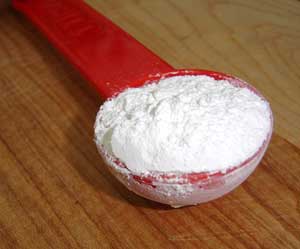
The last five are all chemical properties.
Step 6 is a mixture of tums (calcium carbonate) and baking powder
To test this mixture i crushed the tums and added it to the ½ teaspoon baking powder and ½ cup water. The mixture did nothing, except change the baking soda to the color of the tums. This is a chemical property that was a bust.
Step 7: hydrogen peroxide mixture
This is where the fun begins. I wanted to see what would happen if I used a powerful compound on the baking powder. I was hoping for some serious reaction or maybe even an explosion, but only a small reaction of bubbling occurred. This did occur on impact of the substances. This is a definite chemical property.
Step 8: vinegar mixture
Ok so the calcium carbonate did not work. Maybe an acid would work well with the baking powder. Unfortunately I could not use a really powerful acid, but vinegar works. So I put 1/4th teaspoon baking powder in a cup and drizzled ½ teaspoon vinegar on it. There was a reaction, but not a lot. This is a chemical property.
Step 9: lemon juice
Vinegar did not work so I tried something else. I did have lemon juice on hand so sure why not. I put 1/4th teaspoon baking powder in a cup and added ½ teaspoon lemon juice. Now I suggest that you try this because it is really cool. The lemon juice had a giant reaction with the baking soda. There was a lot of bubbling and the odor did not smell like lemon juice. It smelled rather like a cleaner of some sort, but I have no idea. This is a chemical property.
Step 10: FIRE
O boy this is weird. To test if it could react to fire I used 1/4th teaspoon of baking powder and placed it on a spoon. I ran the spoon over an open flame until red hot and it did not melt. Then I proceeded to angle the flame directly on the baking powder. There was little to no burning. When I say little I mean like there was a tiny dark spot where the flame it part of the powder. This is a very strange chemical property.
Overall this experiment was fun; I enjoyed what would happen when I added this. I you have any cool reactions with baking powder please comment below and state how much of everything you used.
Work cited
Baking Powder. BigOven, 2011. Web. 19 Sept. 2011.<http://www.bigoven.com/uploads/bakingpowder.jpg>
Ceceri, Kathy. Purim Science: Baking Soda vs. Baking Powder. GeekMom. 18 Mar. 2011. Web. 19 Sept. 2011. <http://www.geekmom.com/wp-content/uploads/2011/03/Powder-and-water-209x300.jpg>
Question 20 for Tri 1 review
Three distinct examples of quantum number errors are; (3,3,0,1/2), (2,0,-1,-1/2), (3,1,-1,0). For the first n cannot = lower case L(l). Second there is no -1 orbital for the s sublevel. Number three there is a 0 when there sould be a electron with eather a posotive or negative spin.
